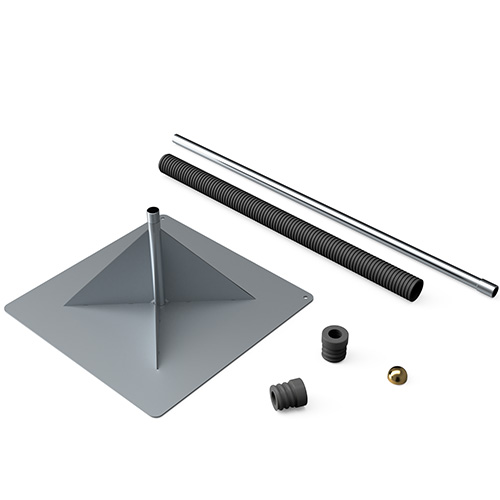

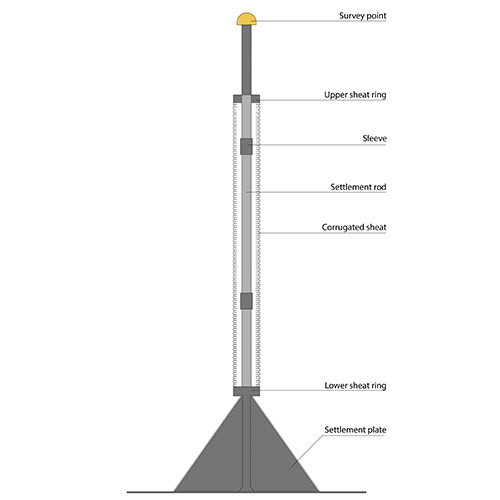
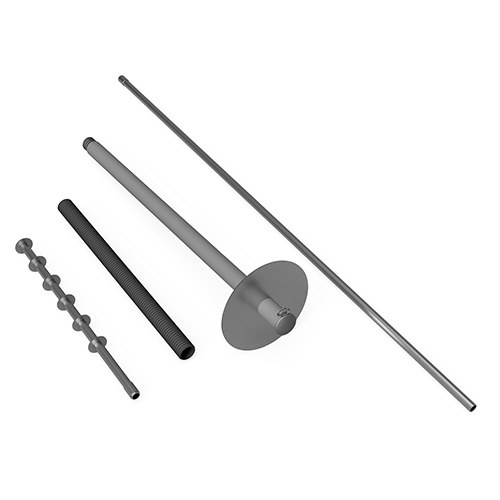
The fixed-point or plate settlement gauge is an instrument designed for monitoring vertical ground settlements, particularly suitable for embankments and geotechnical works where it is necessary to assess the evolution of ground movements (settlements or heave) over time. The system consists of a rod connected to a deep anchorage (Tell-Tale) or to a base plate fixed to the embankment at the required elevation, linked to a measuring rod that transmits displacements up to the surface. Measurements are obtained through topographic readings or, in the case of Tell-Tale systems, via linear displacement transducers, allowing accurate determination of relative settlements of the monitored soil layer with respect to the ground surface. The measuring rod is protected by a corrugated low-friction sleeve that isolates the system from interactions with the surrounding soil, ensuring that recorded displacements are representative solely of the anchorage level. The instrument can be installed prior to embankment construction and progressively extended during the building phases, enabling continuous monitoring of settlements during loading and throughout the subsequent consolidation period. Thanks to their simple construction, robustness, and reliability, fixed-point or plate settlement gauges represent a cost-effective and efficient solution for settlement monitoring and are often used in combination with other instrumentation types for a comprehensive assessment of ground behavior.